
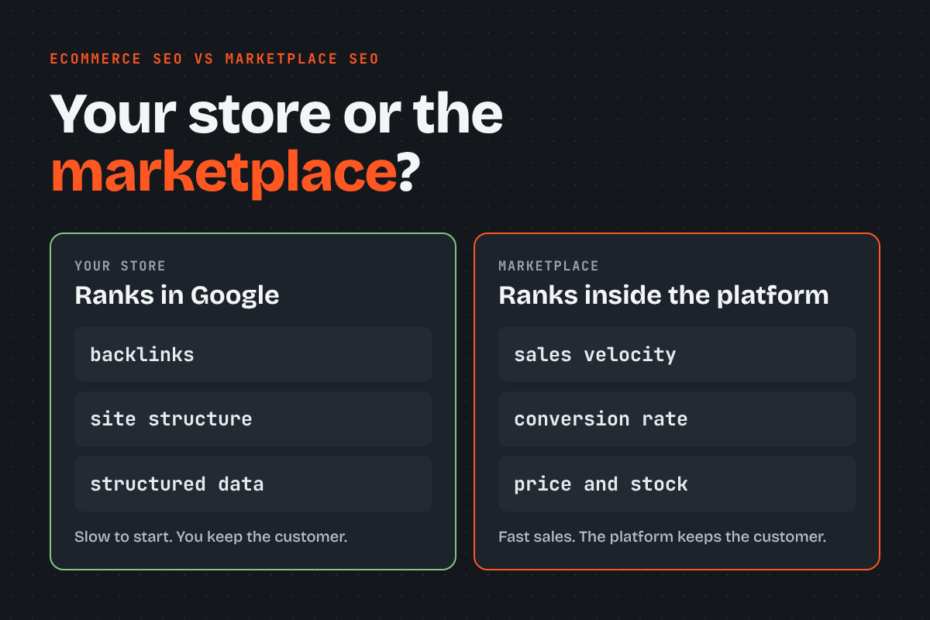
You can make sales faster on a marketplace, but you will only build an independent brand on your own store. Selling online forces a choice between listing on platforms like Amazon and building an independent storefront on Shopify or WooCommerce.
Optimizing both channels requires completely different technical actions, algorithms, and business tradeoffs. Ecommerce SEO ranks your independent website in Google so you own the customer relationship, while marketplace SEO tunes listings inside a single retailer’s search engine to capture shoppers ready to buy immediately.
Key Takeaways
- Ecommerce SEO ranks your independent store in external search engines like Google, whereas marketplace SEO ranks your product listings inside platforms like Amazon, Etsy, and eBay.
- Google rewards topical authority, backlink profiles, technical site structure, and clean product structured data.
- Marketplace search algorithms prioritize transactional metrics, specifically conversion rates, sales history, pricing, and active inventory.
- Marketplaces provide immediate buyer traffic in exchange for high transaction fees and strict control over customer data.
- Ranking a new store on Google takes months for a new domain, while marketplace listings can rank and convert within days when paired with initial sales velocity.
Ecommerce SEO vs marketplace SEO, what is the difference?
Ecommerce SEO targets external search engines like Google and Bing to bring organic traffic to your own website, while marketplace SEO optimizes product pages to appear at the top of an internal platform’s search results.
On your own store, you control the entire technical environment. You decide the URL structure, the site architecture, the layout, and the checkout funnel. Marketplaces, by contrast, force you into a uniform template where you only control specific text fields and product images.
Amazon acts as both an ecommerce retailer and an open marketplace. The company sells its own direct inventory alongside third-party sellers who supply more than half of the platform’s catalog. Because third-party sellers must compete inside Amazon’s internal search bar, marketplace SEO determines whether their inventory is found.
Where each type of SEO ranks your products
The day-to-day optimization work looks different on your own domain compared to a third-party seller account.
Ecommerce SEO on your own store
Ecommerce SEO involves getting your store’s homepage, category hubs, and individual product pages to index and rank in Google. A typical store organizes products into logical parent and subcategory pages, such as a category page for leather boots branching into individual boot model URLs.
As the store owner, you write custom title tags, configure meta descriptions, build internal navigation links, and write original product copy. You also fix crawl waste, manage canonical tags, and publish structured data so search engines understand your pricing and availability.
Marketplace SEO on Amazon, Etsy and eBay
Marketplace SEO involves optimizing your listing to win visibility inside the search engines built by Amazon, Etsy, and eBay. Your product competes directly against identical or similar items displayed in a standardized grid.
The marketplace dictates the layout and design of every page. You provide titles, bullet points, backend attributes, and images, but the platform decides where customer reviews sit, which related items appear on your listing, and who wins the purchase button.
Own store and marketplace SEO side by side
The table below outlines how ranking factors, content ownership, and traffic dynamics differ across direct web stores and the major retail marketplaces.
| Channel | Where shoppers search | What mainly ranks a product | Control over listing content | Traffic you start with | Customer data you keep |
|---|---|---|---|---|---|
| Own store (Shopify, WooCommerce) in Google | Google, Bing, direct browser navigation | Backlinks, page relevance, site structure, technical performance | Complete control over layout, code, and copy | Zero initial visitors | Full customer email and purchase history |
| Amazon | Amazon search bar | Sales velocity, keyword relevance, review score, price, stock | High restrictions on text length and image styling | Millions of active shoppers | None; communications stay on platform |
| Etsy | Etsy search bar | Query matching, listing quality score, customer service record | Fixed template with rigid tag and attribute fields | Established base of craft and gift buyers | depending on Etsy data retention policy |
| eBay | eBay internal search (Cassini) | relevance to the buyer’s search query, seller performance, and listing quality | Template options exist, but listing structure is restricted | Large global buyer base | depending on eBays data retention policy |
Ranking signals on Google versus marketplace search
Those differences in control and traffic trace back to how each platform ranks content. Search engines and marketplaces evaluate content differently because their revenue models differ. Google profits when a user finds relevant information, while marketplaces profit only when a shopper buys a product.
What Google rewards on store pages
Google evaluates your entire domain alongside the specific page requesting to rank. Its algorithm weighs content relevance, mobile performance, page speed, and clean structured data markups like Product schema.
Site architecture also determines how easily Google crawls your catalog. Keeping every product listing within a target click depth of three clicks ensures search bots discover your inventory without wasting crawl resources.
Backlinks act as external votes of authority for your domain. When an industry publication or niche blog links directly to your category page, Google views that category page as an authoritative source. That earned authority flows through internal navigation links down to your individual products, lifting their search visibility.
What Amazon, Etsy and eBay reward
Marketplace algorithms focus heavily on customer conversion. The Amazon ranking algorithm, commonly referred to by the industry labels A9 or A10, weighs keyword relevance alongside sales velocity, conversion history, price competitiveness, customer reviews, and available inventory.
External backlinks do not pass algorithmic authority to an Amazon listing in the same way they power a standalone store. While outside links can drive raw referral traffic to a listing, the listing only climbs internal rankings if that traffic converts into paid orders. Claimed weighting for specific factors in the A10 update, such as internal sales versus off-site sales, remains undocumented by Amazon .
Etsy evaluates listings through a distinct process. It matches search terms to listing titles, tags, categories, and attributes, then adjusts rank using a listing quality score based on conversion rates, positive reviews, and shop policy compliance.
Keyword research and listing copy on each platform
Because each platform ranks differently, keyword research methods reflect the search behavior of each audience. Store owners target informational and navigational queries alongside transactional keywords, whereas marketplace sellers target strictly transactional search terms.
Store keyword research relies on Google data through tools like Ahrefs, Semrush, or Google Keyword Planner. Marketplace sellers instead look at internal platform demand using Amazon autocomplete, Etsy search suggestions, and Amazon Brand Analytics. Amazon also provides access to actual customer search funnels via its Search Query Performance tool, which is available to sellers with a Professional selling account and Brand Representative status for a brand enrolled in Amazon Brand Registry.
Listing copy must obey different formatting rules:
- Marketplace title limits: Amazon enforces strict category-specific character limits, often capping titles at 200 characters. Etsy recommends shorter, readable titles that front-load core search terms while strictly enforcing a limit of 140 characters.
- Store title tags: An independent store owner writes title tags to fit Google search result snippets, typically keeping them under 60 characters so they display cleanly without truncation.
- Hidden search fields: Marketplaces provide dedicated backend search term fields, such as Amazon backend keywords or Etsy’s 13 search tags. Independent stores do not have an identical backend indexing field for Google, relying instead on clean on-page text, header tags, and internal link anchors.
Marketplace sellers often reuse manufacturer product descriptions across identical items. Doing this on your own independent store damages organic performance, because Google devalues duplicate copy and chooses to index more established domains displaying that exact text.
Traffic, selling fees and customer data ownership
Beyond rankings, the channels differ in what they hand you on day one. Marketplaces come with an audience built in. Millions of consumers visit Amazon and Etsy daily with payment methods already saved, ready to buy. A newly launched standalone store begins with zero daily visits and must generate every visitor through organic search, paid advertising, or social media.
That convenience carries an ongoing cost. Marketplaces charge a percentage of every order:
- Amazon fees: Referral fees typically range from 5% to 45% depending on the product category, in addition to optional fulfillment fees.
- Etsy fees: Sellers pay listing fees, payment processing costs, and a transaction fee of 6.5% of the total sale (as of October 2026).
- Independent store fees: A Shopify or WooCommerce store requires monthly hosting and app subscriptions, plus credit card processing fees that typically sit between 2% and 3%.
The most significant difference lies in data ownership. An independent store collects customer emails, SMS opt-ins, and browsing histories, allowing you to run automated email campaigns and earn repeat purchases at zero marginal marketing cost. Marketplaces block you from collecting email addresses, which leaves your business exposed if a platform changes its search algorithm, increases seller fees, or suspends your account.
How long each takes to bring sales
Marketplaces generate revenue within days of product launch, whereas an independent store typically requires more than three months to generate meaningful organic traffic from Google.
Marketplace SEO: [Product Launch] -> [PPC / Early Orders] -> [Rankings Rise] -> Days to WeeksEcommerce SEO: [New Domain] -> [Indexing & Links] -> [Authority Grows]-> Months
A brand-new store domain lacks historical authority and backlinks. Search engines crawl new sites cautiously, meaning category and product pages take weeks or months to climb search result pages, even with clean technical foundations.
Marketplace listings bypass the domain authority waiting period. Because your listing is hosted on an established domain like Amazon or eBay, it is indexed internally the moment it goes live. Generating sales velocity through initial price discounts or platform pay-per-click ads immediately pushes your listing up the internal search rankings.
The catch is that marketplace search visibility drops quickly if your sales volume slows, your inventory runs out, or you turn off sponsored ads. A store page that achieves strong organic rankings in Google, however, continues to collect traffic and sales organically without requiring continuous ad spend.
Which should you focus on first?
Given those tradeoffs in speed, cost, and ownership, your current capital, brand recognition, and catalog size dictate where to focus your initial search optimization efforts.
- Start with marketplace SEO: If you are launching a product with existing consumer demand, have zero audience, and need sales immediately to fund inventory, put your time into marketplace SEO. Marketplaces provide the fastest conversion validation for generic or low-differentiation products.
- Start with ecommerce SEO: If you manufacture unique items, protect high profit margins, rely on repeat orders, or sell items that marketplaces prohibit or heavily commoditize, prioritize your own storefront.
You can operate both channels simultaneously without harming your website’s organic visibility. Write unique, comprehensive content for your direct store’s product pages, and upload concise, feature-driven copy with distinct titles to your marketplace listings. This separation ensures your own store targets long-tail search intent on Google without competing directly against duplicate copy on high-authority marketplace pages.
If your independent store is struggling to gain visibility in Google, get a free SEO audit to identify exactly what is holding your content back.
Frequently asked questions about store and marketplace SEO
Do Amazon listings show up in Google and compete with my store?
Marketplace listings frequently rank on the first page of Google for product-specific queries. Because Amazon and Etsy carry massive domain authority, Google often ranks marketplace product pages above independent websites for competitive search phrases.
This can divert clicks away from your store if your listings and store pages use identical product titles. To minimize overlap, optimize your store pages for your distinct brand name and specific long-tail buyer phrases, while using the marketplace listing to target broad, high-volume generic keywords.
Does selling on a marketplace help my own store’s SEO?
Marketplace sales do not directly pass link equity or algorithmic ranking authority to your independent website. Marketplaces do not provide standard followed backlinks to external merchant websites.
However, high marketplace sales volume drives indirect search benefits. Consumers who discover your product on Amazon often use Google to search for your brand name directly before making future purchases. While Amazon enforces strict guidelines regarding off-platform marketing (inserts directing buyers off-platform are prohibited: sellers may not provide links or messages that prompt users to visit an external website or complete a transaction elsewhere), packaging inserts that offer warranty registration or customer service can convert marketplace shoppers into direct store buyers within platform rules.
Is Google Merchant Center free to use?
Google Merchant Center lets merchants list products in Google Shopping search results at no cost through its free listings program. Unlike paid Shopping ads that charge per click, free listings appear organically in the Shopping tab and within main search results.
To access free listings, a store owner must set up a Merchant Center account, verify domain ownership, and submit an accurate product feed containing attributes like titles, pricing, availability, and GTIN codes. Paid Shopping ads run through Google Ads and require bids, while free listings rank purely on product relevance, feed accuracy, and competitive pricing.