
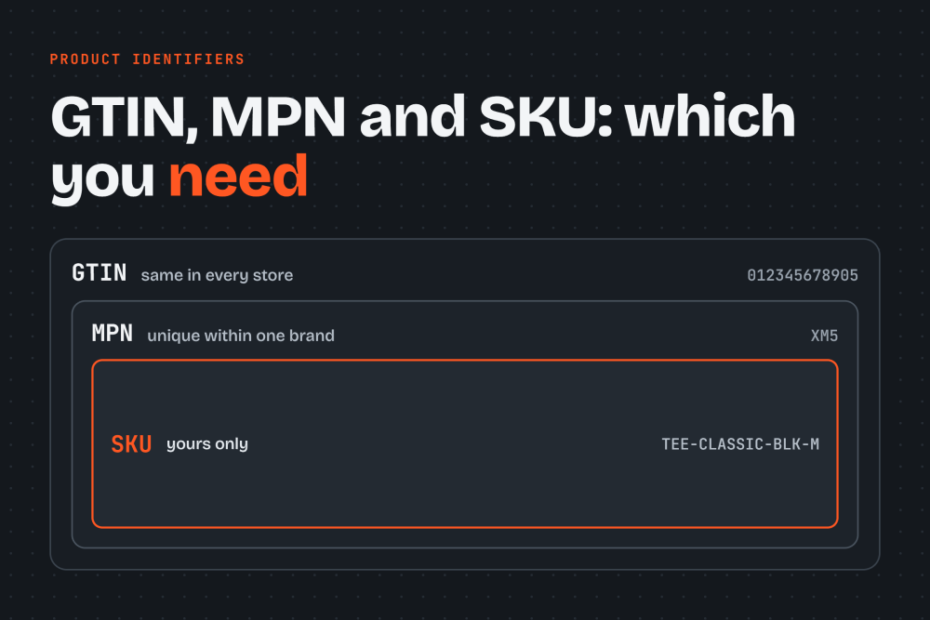
GTIN, MPN and SKU: which you need
A GTIN is the number under a product’s barcode, assigned through GS1 and identical in every store, while an MPN is the manufacturer’s own part code, which identifies a product only when paired with the brand. A SKU is a code you write yourself to track stock. Online sellers must usually supply the GTIN and brand plus MPN to sales channels, whereas the SKU is optional for channels but essential for your own inventory.
You usually end up holding all three because they answer different questions. The channel asks what the product is globally (GTIN), the manufacturer’s catalog says which part it is (MPN), and your warehouse needs to know which shelf bin to pick from (SKU).
Marketplaces make the GTIN matter most, because they typically merge offers from many sellers onto one product page and use the GTIN to decide which offers belong together.
Key Takeaways
- A GTIN is globally unique, an MPN is unique only with its brand name, and a SKU is unique only inside your own store.
- UPC and EAN are both GTINs: a UPC has 12 digits, an EAN has 13.
- Google Merchant Center asks for a GTIN first and accepts brand plus MPN when no GTIN exists.
- Marketplaces use the GTIN to match your offer to an existing product page, so a wrong or missing GTIN can get the listing rejected or attached to the wrong product.
- Barcodes bought from resellers can be rejected, so buy your own GTINs from GS1.
- Every variant needs its own SKU, or your stock counts merge.
- Handmade and custom goods can usually skip the GTIN through an exemption.
GTIN, MPN and SKU defined in plain terms
All three codes can appear on the same item, so seeing them side by side on one example removes most of the confusion.
- GTIN stands for Global Trade Item Number, and on a retail package it is the digit string printed under the barcode, for example 012345678905 on a US product. GS1, the standards body that runs the system, issues it to the brand owner, so every retailer scanning that package reads the same number.
- MPN stands for Manufacturer Part Number. It often matches the model number printed on the product, but the two are not always the same, since some manufacturers keep a separate internal part code. An MPN such as “XM5” can repeat across brands, so it identifies a product only when paired with the brand name.
- SKU stands for Stock Keeping Unit. You create it, and a good one encodes the product, color and size, such as TEE-CLASSIC-BLK-M for a medium black classic tee, because a well-built SKU lets a picker read the variant from the code alone.
Product codes compared side by side
The codes differ most in how far their uniqueness reaches.
| Attribute | GTIN | MPN | SKU |
|---|---|---|---|
| Assigned by | Brand owner, via GS1 | Manufacturer | You, the seller |
| Format | 8, 12, 13 or 14 digits | Letters and numbers, any length | Letters and numbers, your design |
| Unique across | Every store worldwide | One brand’s catalog | Your store only |
| Cost | GS1 membership or per-code fee | Free | Free |
| Required by | Google Merchant Center and Amazon in most cases | Google when no GTIN exists (with brand) | No channel |
| Main use | Matching products across channels | Identifying parts and models | Inventory and picking |
Global uniqueness is the attribute that decides which code a sales channel asks for. A channel merging offers from thousands of sellers needs a code that means the same thing everywhere, so it asks for the GTIN first and falls back to brand plus MPN only when no GTIN exists.
How UPC, EAN and GTIN-14 fit inside GTIN
The table shows GTIN as a family of 8 to 14 digit formats, so you need to identify which format your existing barcode is before you know whether you already hold a GTIN. The formats are:
- GTIN-8: 8 digits, used on very small packages where a longer barcode will not fit.
- GTIN-12: 12 digits, better known as the UPC, used mainly in the US and Canada.
- GTIN-13: 13 digits, better known as the EAN, used in Europe and most other regions.
- GTIN-14: 14 digits, used on cases and multipacks that contain several retail units.
A UPC and an EAN both count as GTINs, so if your product carries either one, you already hold a GTIN. The question “is GTIN 13 or 14 digits” has no single answer because the length depends on the format, and the 14-digit version identifies a shipping case rather than the item on the shelf.
A GTIN and a barcode are also different things. The GTIN is the number, while the barcode is the printed symbol of bars that encodes it. The final digit of every GTIN is a check digit calculated from the others, so a mistyped number fails validation in most feed tools.
For a single retail unit, enter the 12-digit or 13-digit GTIN in your product feed. Use the 8-digit version only if that is what the package actually carries.
Who assigns each code and what it costs
Once you know which format you need, you have to obtain it, and the three codes come from three different places:
- GTIN: you get it from GS1, either as a company prefix, which licenses a block of numbers, or as a single GTIN. Prices change, so confirm them on the GS1 US site: it currently lists $30 for a single GS1 US GTIN; $250 initial fee for a 10-item company prefix.
- MPN: the manufacturer assigns it at no cost to you.
- SKU: you write it yourself at no cost.
Barcodes sold by resellers are cheaper but carry a risk, because their numbers may not be registered to your brand in the GS1 database and channels can reject a code that does not match the brand you list. Buying directly from GS1 should avoid that mismatch, because the number is registered to your company.
When you resell another brand’s goods, find the MPN on the product label, the manufacturer’s spec sheet, or your supplier’s catalog. Copy it exactly, including hyphens, because a changed character breaks matching.
You can make up your own SKUs freely, but two rules keep the system usable: one SKU per variant, and never reuse a retired code, because old orders and reports would then point at the wrong product.
Identifiers Google Merchant Center and Amazon require
Because GTINs are issued by outside bodies while SKUs are yours to invent, the sales channels you list on decide which codes you must actually supply. Google leans on GTINs and brand plus MPN, while Amazon leans on GTINs and its own ASIN catalog.
Google Merchant Center product identifier rules
Google requires a GTIN for any product that has one assigned by its manufacturer. When no GTIN exists, you submit the brand plus the MPN instead. A listing missing the identifiers it should carry can show a limited performance warning, and a missing GTIN can mean fewer impressions because Google cannot match the product to its catalog. Google’s current wording is that products missing identifiers “may have limited visibility”.
Set identifier_exists to no only for products that genuinely have no GTIN or MPN, such as handmade or custom items. Your SKU does not count as a product identifier. The id attribute in a feed is your own unique reference for the item, and Google treats it as internal.
Amazon GTIN requirement and exemption
Amazon requires a GTIN to create a new listing in most categories, so without one or an approved exemption the listing cannot be created. If you sell your own brand, a private label, or handmade goods with no GTIN, you can apply for a GTIN exemption in Seller Central, and Brand Registry holders can often list without one. Sign into Seller Central, search for “Apply for GTIN exemption”, select the product category and enter the brand, check eligibility, and provide product details (brand, category, brand owner approval letter where it applies, and at least two images of the product and packaging showing it has no UPC); private label sellers must be enrolled in Brand Registry.
Three identifiers then coexist on Amazon: the GTIN identifies the product globally, the ASIN is Amazon’s own catalog number for the listing, and your seller SKU tracks your stock of it.
Frequently asked questions about GTIN, MPN and SKU
Is an MPN a serial number?
No. An MPN identifies a model shared by every unit, while a serial number identifies one individual unit. A laptop might carry the MPN “XPS9530” on every unit and a serial number like “7K2L9QX” on only yours.
Can two products have the same SKU?
Not within one store. Each variant needs its own SKU, or the stock counts merge and you oversell. Across different retailers, the same item will carry different SKUs, which is expected because each seller writes their own.
Is a SKU the same as a UPC number?
No. The UPC is a 12-digit GTIN registered through GS1 and identical at every store, while the SKU is a code the seller writes, often mixing letters and numbers. A product has one UPC but can carry a different SKU at every retailer.
Is an MPN a SKU?
No. The manufacturer assigns the MPN and it stays the same at every retailer, while the seller assigns the SKU for its own inventory. Some sellers reuse the MPN as their SKU for convenience, which works until two suppliers share an MPN.
Fill in your product identifiers before you list
Once the FAQ has settled which codes your product type needs (a GTIN for resold branded goods, an MPN where the manufacturer assigns one, and a SKU for every variant), the last step is to enter those codes into your store and your markup. In Shopify, the variant editor has a Barcode field for the GTIN and a separate SKU field, although MPN needs a custom field or app. No, Shopify has no native MPN field. In Product schema markup, the matching properties are gtin (or gtin12 and gtin13), mpn and sku.
Work in this order, because the SKU is the only code fully in your control and the feed depends on the others:
- Assign a SKU to every variant.
- Collect manufacturer GTINs, or buy yours from GS1.
- Record each MPN.
- Submit the feed.
Before you submit, check that no two variants share a SKU and that every GTIN passes check-digit validation.
If you run a marketplace instead of selling on one, the same identifiers decide how you handle duplicate listings. Sellers upload the same product many times with different SKUs, and the GTIN or MPN plus brand is how you consolidate them onto one canonical page. Step 4 of my marketplace SEO guide.
For a full review of a marketplace’s indexation and listing structure, see my marketplace SEO service.